Back to Blog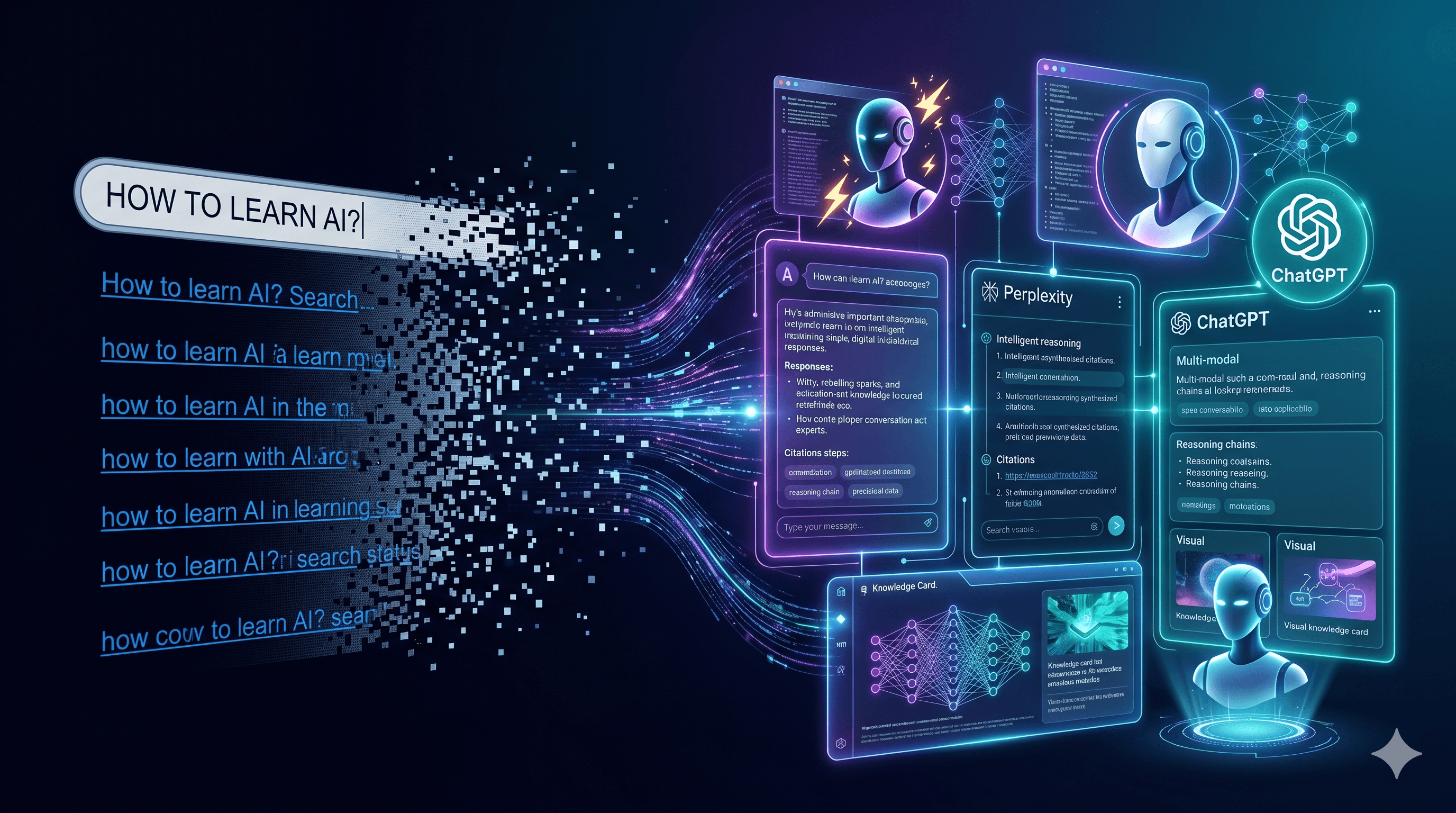
Technology
June 5, 2026
Rohan Takke
8 min read
The Death of Traditional Search: How Grok, Perplexity, and ChatGPT Are Rewriting How We Find Information
How Grok, Perplexity, ChatGPT, and a wave of AI challengers are dismantling the blue link empire, one answer at a time.
Generated by Gemini
The Death of Traditional Search
Picture the scene: it's 1999, and you've just discovered that a little white box can answer virtually any question you can type. You feel like you've been handed a library card to the entire internet. You are, in the language of the era, Googling something and it is miraculous.
Fast forward to today. That same white box returns a wall of ads, three near identical SEO stuffed articles, a featured snippet that technically answers your question but somehow leaves you more confused, and a handful of Reddit threads that the algorithm is desperately trying to surface because at least someone real wrote them. The miracle has become a chore.
And into that frustration stepped a new breed of tools AI-powered, conversational, and ruthlessly efficient. They don't show you ten links. They just answer. And the world is quietly losing its mind about it.
By the Numbers
| Metric | Stat | Source |
|---|---|---|
| ChatGPT global monthly active app users (June 2026) | 1 billion | Sensor Tower / Reuters |
| ChatGPT weekly active users (Feb 2026) | 900 million | OpenAI (official announcement) |
| Perplexity monthly active users across all surfaces (Apr 2026) | 100 million+ | fatjoe.com / Perplexity |
| Perplexity ARR growth — late 2025 to Apr 2026 | $200M → $500M | fatjoe.com |
| AI search visits growth YoY — Q1 2025 to Q1 2026 | +42.8% (15.6B → 27B visits) | Wix AI Search Lab |
| AI search traffic share vs Google (Q1 2026) | 9.2% | Wix AI Search Lab |
| ChatGPT's share of general search queries (Aug 2025) | 12.5% (up from 4.1% in Feb 2025) | StanVentures / SparkToro |
How We Got Here: The Blue Link's Slow Funeral
Google's dominance was never really about search. It was about organizing, taking a chaotic, link drunk web and ranking it into something navigable. For two decades, that was enough. But the web changed. Content farms metastasized. SEO became an arms race. Ads crept from sidebars to top-of-page to inside the results themselves. The blue link, once a portal to knowledge, became a commercial corridor.
Users didn't rebel loudly. They just quietly started adding "Reddit" to every search query — a wildly popular hack that essentially meant: please, someone human, just tell me the truth. That instinct, the desire for a direct, trustworthy, conversational answer, is exactly what AI search is now selling. And people are buying.
Adding 'Reddit' to every Google search wasn't a quirk, it was a distress signal. AI search is the answer that signal was always asking for.
Meet the Challengers
The players reshaping this space aren't a monolith. Each is betting on a different version of the future:
Perplexity AI — Citation-First
The closest thing to a "Google killer" in spirit. Perplexity synthesizes web sources in real time and cites them inline, threading the needle between AI confidence and journalistic accountability. It grew from zero to 100M+ monthly users faster than almost any product in history.
ChatGPT Search — Conversational
OpenAI bolted real-time search onto ChatGPT and changed the game overnight. Its superpower isn't just finding information — it's reasoning about it. You can ask follow-ups, set context, and get answers tailored to your exact situation. The search box as dialogue partner.
Grok (xAI) — Real-Time X Data
Elon Musk's AI has one card no one else holds: live access to the full firehose of X (formerly Twitter). For breaking news, trending discourse, and the unfiltered pulse of public opinion, Grok operates in a timeline where most AI tools are still playing catch-up.
Google Gemini — The Incumbent Fighting Back
Google didn't sit still. AI Overviews (formerly SGE) now summarize results before you click anything, a move that simultaneously saves users time and terrifies the publishers who depend on that click. Google is, somewhat paradoxically, the biggest threat to its own search business.
What AI Search Actually Does Differently
The shift isn't cosmetic. Traditional search is a retrieval engine, it finds documents that match your keywords. AI search is a synthesis engine, it reads those documents, extracts the relevant parts, and composes an answer written for you, right now, in plain language.
This matters enormously. When you ask "should I take ibuprofen or paracetamol for a headache after drinking last night?", Google returns articles about both drugs, some warnings, a Mayo Clinic FAQ, and a few Reddit threads. Perplexity or ChatGPT answers your actual question, considering the alcohol context, the timing, the liver load, in two paragraphs. No clicking. No scrolling past ads. No reading three articles to triangulate the truth.
That efficiency isn't a feature. It's an entirely different relationship with information.
We're not searching anymore. We're consulting. The mental model has flipped, from 'where do I look?' to 'just tell me.'
The Casualties: Publishers, SEO, and the Open Web
Every revolution has its wreckage. The AI search wave is proving no different. Publishers who built traffic models on Google's referrals are watching click-through rates collapse. If the AI answers the question, there's no reason to visit the source. Why would you?
This creates a deeply uncomfortable paradox: AI search is trained on the content that publishers create, yet its very success threatens to defund the journalists, writers, and researchers who create that content. It's the information equivalent of a factory that consumes the forest it needs to keep running.
SEO, meanwhile, is having an identity crisis. For twenty years, the game was: produce content structured for Google's crawlers. Now? The crawler is also the reader, the synthesizer, and the final answer. Optimizing for AI search means writing content that is genuinely useful, deeply accurate, and worth citing, which, frankly, is what good writing always was.
Is the Answer Always Right? Not Even Close.
Here's the part the evangelists conveniently skip: AI search hallucinates. It confabulates. It produces confident, beautifully formatted, utterly wrong answers with the smooth assurance of a pathological liar at a job interview. Ask about a niche historical figure, a recent court ruling, or a technical specification and the AI might just invent the details, because completion feels better than admitting uncertainty.
Perplexity's citation model helps. But citations can be misread, misrepresented, or cherry-picked. ChatGPT's search integration improves factual grounding but doesn't eliminate the fundamental tension between generating fluent text and being accurate. Google's AI Overviews have published some genuinely spectacular errors including famously suggesting people eat rocks for nutrition (a satirical article, taken as fact).
The danger isn't that AI search is bad at finding information. The danger is that it's very good at sounding right. And in a world already drowning in misinformation, a confident wrong answer delivered at the top of the page is a new kind of threat.
So Is Google Dead?
Not yet. Probably not soon. But "not dead" and "not threatened" are very different things. Google's share of the search market which sat comfortably above 90% for a decade has begun to slip for the first time in its history. More significantly, the behavior of users is changing, particularly younger ones who have grown up treating ChatGPT as a default first stop for anything they need to know.
Google's response - AI Overviews, Gemini integration, the rapid evolution of Search Generative Experience reveals a company that is not oblivious to the threat. But it's an incumbent's response: reactive, protective of existing revenue models, cautious not to cannibalize the ad business that pays for everything. That caution may be exactly what gives the challengers room to run.
The Future: Search as Conversation, Discovery as Dialogue
The most interesting version of the future isn't the one where AI replaces search. It's the one where the distinction dissolves entirely. Where the act of looking for information and the act of understanding it become a single, continuous conversation.
Imagine asking about a trip to Japan and instead of opening fifteen tabs, you talk to a system that knows your budget, your travel history, your preference for obscure temples over tourist traps, and the fact that you're vegetarian. It doesn't return results. It builds an itinerary, asks clarifying questions, adjusts in real time, and books the hotel when you say yes. That's not search. That's a thinking partner.
We are, right now, at the very beginning of that transition. The blue link isn't dead but it is, unmistakably, dying. What replaces it will be faster, smarter, and far more personal. Whether it will be more trustworthy is the question that everyone building these systems needs to take seriously before the market decides they don't have to.
The blue link isn't dead. But it is, unmistakably, dying and what comes next is simultaneously the most exciting and the most dangerous information shift in a generation.
The death of traditional search isn't a tech story. It's a story about how humans relate to knowledge and who, or what, gets to be the trusted voice that hands it to us. That question has always mattered. Now, more than ever, it matters enormously.
References
- https://www.demandsage.com/chatgpt-statistics/
- https://fatjoe.com/blog/chatgpt-stats/
- https://www.getpanto.ai/blog/chatgpt-statistics
- https://fatjoe.com/blog/perplexity-ai-stats/
- https://backlinko.com/perplexity-statistics
- https://www.businessofapps.com/data/perplexity-ai-statistics/
- https://www.wix.com/studio/ai-search-lab/research/ai-search-vs-google
- https://www.stanventures.com/news/how-people-search-in-2025-are-we-seeing-a-revolution-in-search-behavior-4206/
- https://sociallyin.com/search-engine-statistics/
- https://linkplacement.com/google-search-market-share/
- https://blog.bloola.com/digital-change/the-shifting-landscape-of-information-retrieval
- https://www.seerinteractive.com/insights/aio-impact-on-google-ctr-september-2025-update
- https://searchengineland.com/google-ai-overviews-drive-drop-organic-paid-ctr-464212
- https://searchengineland.com/google-ai-overviews-hurt-click-through-rates-454428
- https://www.emarketer.com/content/google-ai-overviews-decrease-ctrs-by-34-5-per-new-study
- https://www.searchenginejournal.com/impact-of-ai-overviews-how-publishers-need-to-adapt/556843/
- https://digiday.com/media/in-graphic-detail-ai-platforms-are-driving-more-traffic-but-not-enough-to-offset-zero-click-search/
- https://blogherald.com/blogging-news/the-zero-click-era-is-here-and-publishers-are-still-pretending-it-isnt/
- https://thedigitalbloom.com/learn/2025-organic-traffic-crisis-analysis-report/
- https://www.pymnts.com/news/artificial-intelligence/2025/consumers-use-ai-chatbots-online-searches-brands-scramble-be-seen/
- https://www.adexchanger.com/publishers/the-ai-search-reckoning-is-dismantling-open-web-traffic-and-publishers-may-never-recover/
- https://quickseo.ai/blog/ai-search-vs-google-search-in-2026-40-stats-that-show-why-your-brand-needs-to-track-both
- https://www.datatechandtools.com/p/publishers-face-a-new-reality-when
- https://superprompt.com/blog/zero-click-search-worsens-58-percent-google-no-clicks-november-2025-recovery-strategies